Fighting cancer is like writing code—every body signal is a variable, and all we need to do is record accurately and analyze scientifically.
To all care partners, let’s solve rehabilitation problems with logic. I’ve been taking care of my father with lung cancer for 3 years, and let me tell you—those first few months were a mess.
Piles of medical records, test results, medication lists piling up on my study desk. Follow-up visits? I’d spend 10 minutes rummaging through papers, sweating, trying to find that one CT report the doctor asked for. Missed treatment nodes, mixed-up medication dosages. Frustrating. Demoralizing, even.
I’m a programmer by trade—so I thought, why not use the logic I use for code to fix this? At first, I tried sorting everything into folders. Paper folders, digital folders, color-coded labels. Seemed good, right?
Wrong. Too many files. Too much clutter. My father’s condition changed fast—some days, the doctor needed to compare his blood work from 6 months ago with today’s. Flipping through folders, scrolling through unorganized files? Waste of time. Time we couldn’t afford to waste.
Wait, where’s that blood test report? The one from last month. Can’t find it. Crap, the doctor’s waiting. I’m staring at the screen, eyes burning, neck stiff—hours of sorting, and I still can’t find a single document. Staring at the messy desktop, I sighed. Spilled coffee on the keyboard while reaching for a folder—quick wipe, keep going. Gotta fix this.
Technology shouldn’t be cold code; it should be the most powerful navigator in a caregiver’s hands. That’s when I decided to build my own digital medical record management system. Simple, practical, no fancy bells and whistles—just what we need.
First, the three-level classification system. Level 1: Diagnosis/Treatment/Follow-up. Level 2: Imaging/Laboratory/Medication. Level 3: Broken down by year and month. No more guessing where a report goes. For example, a CT scan from March 2024 goes to Follow-up > Imaging > 2024-03. Simple, right?
Then, the Excel dynamic index table. Game-changer. I created a table with columns: Date, Report Type, File Name, Key Notes, and Hyperlink. Every time I scan a paper report, I name it with the date + report type—like “2024-03-15-CT-Lung”—then link it to the Excel cell. One click, and I’m looking at the scan. No more searching through hundreds of files.
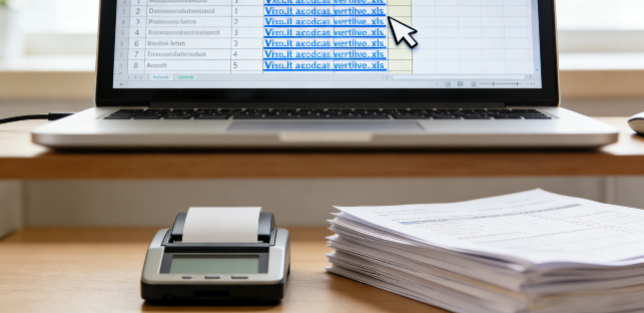
I was debugging the Excel formula last week—suddenly, the printer jammed. I groaned, got up, fixed it, came back.The neighbor’s dog barked outside the window—I paused for a second, then went back to typing the formula, my train of thought suddenly clearer.Turns out, a simple IF function was all I needed to auto-sort the index by date. Now, the table updates automatically when I add new entries.
Scanning all paper documents is non-negotiable. Trust me. I learned the hard way—backup, forgot to do it once. Hard drive crashed, lost a month of medication records. Panicked. Spent all night recovering what I could. Now, I scan every paper report the same day I get it—resolution set to 300 DPI, so the numbers are clear. Save them to both my laptop and cloud storage. Two backups, no more mistakes.
Scanning paper records, fingers got cut by the edge of a report. Tiny cut, stings a little. Grabbed a band-aid, kept going. Worth it. Last follow-up, I pulled up the Excel index, clicked the hyperlink for his latest blood work, and the doctor raised an eyebrow. “This is impressive,” he said. “I wish more caregivers were this organized.”
Actually, it’s not that hard. You don’t need to be a programmer. Just use the tools you have—Excel, a basic scanner, cloud storage. Let’s break down the process like a code project: one step at a time, no rush.
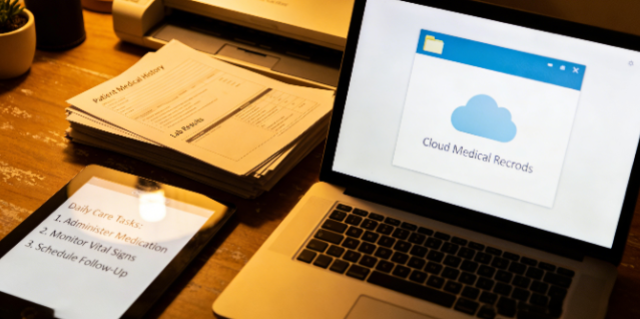
I’m sitting at my desk now, sorting today’s medication record. The Excel index is open on one screen, the scanned report on the other. Technology shouldn’t be cold code; it should be the most powerful navigator in a caregiver’s hands. Every minute we save on rummaging through records is a minute we can spend with our loved ones.
I dragged the organized folder to the cloud, about to close my laptop. Wait—forgot to log today’s pain level. Father mentioned it this morning, I jotted it down on a sticky note. Gotta add that to the Excel table. Fingers hovering over the keyboard, thin calluses from years of coding brushing the keys. Just one more entry, then I can check on him.